 by
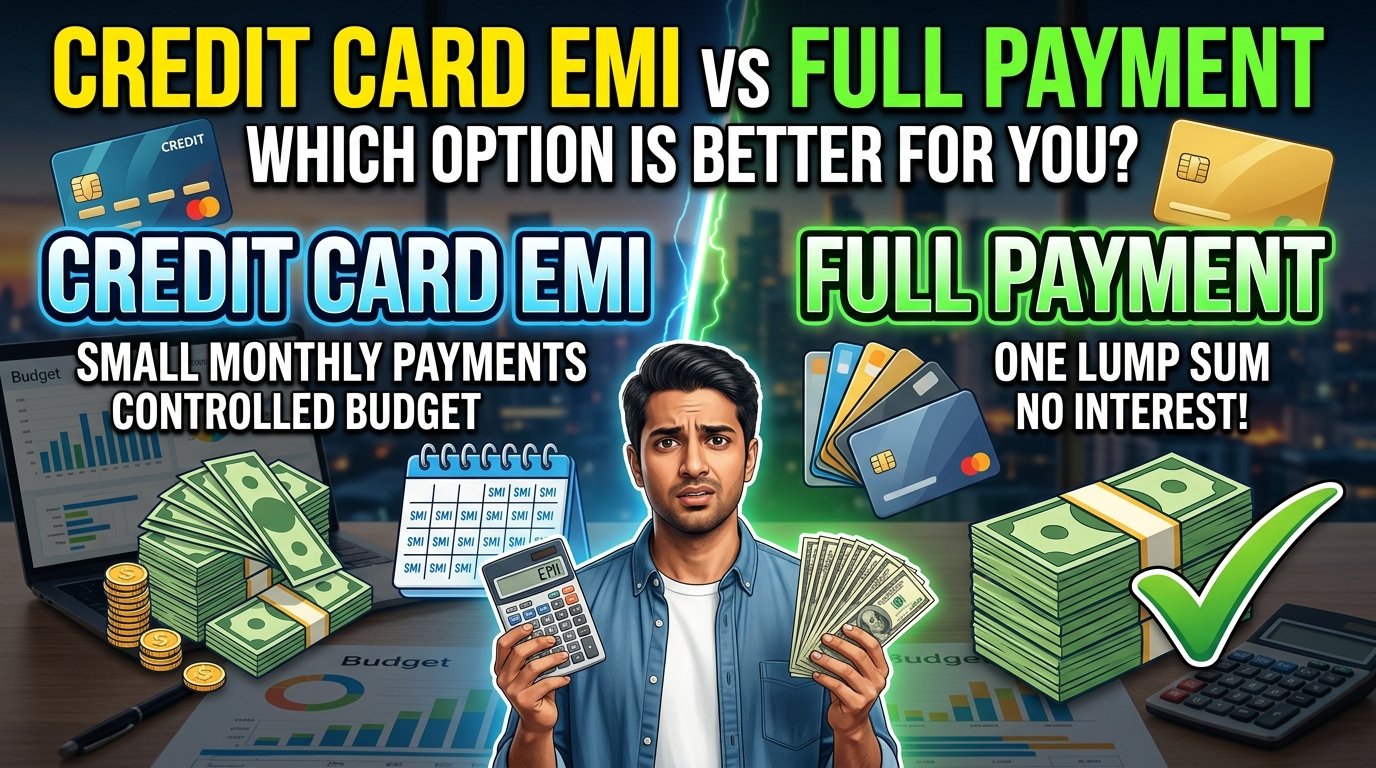
by Credit cards give you flexibility when making purchases, especially when you need to buy something expensive. After a purchase, you may have the option to pay the full amount on your credit card statement or convert an eligible purchase into an EMI or installment plan.
Both options can be useful in different situations. Full payment can help you avoid certain interest charges, while EMI can make a large purchase easier to manage through smaller scheduled payments. However, EMI plans may include interest, processing fees, or other charges depending on the card issuer and offer.
So, credit card EMI vs full payment—which option is better for you?
The answer depends on your budget, the cost of the EMI plan, and your ability to repay the purchase.
What Is Credit Card Full Payment?
Full payment means paying the entire amount shown as your statement balance by the payment due date, according to your card’s terms.
For example, if your statement shows a balance of ₹30,000, you pay the full ₹30,000 by the due date.
For many credit cards, paying the full statement balance on time can help you avoid interest on eligible purchases when the card’s grace-period terms are met.
Full payment is generally the simplest option because you do not have to manage multiple installments for the purchase.
What Is Credit Card EMI?
EMI stands for Equated Monthly Installment. It allows an eligible purchase to be repaid through a series of scheduled monthly payments rather than paying the entire purchase amount at once.
For example, suppose you purchase a laptop for ₹60,000 and choose a six-month EMI plan. Instead of paying the entire amount immediately, you make monthly payments according to the EMI agreement.
However, the total cost may be higher than ₹60,000 if the plan includes interest, processing fees, taxes, or other applicable charges.
Some issuers also offer promotional “no-cost EMI” plans, but these should still be reviewed carefully because the final terms can vary.
EMI vs Full Payment: Quick Comparison
| Feature | Full Payment | Credit Card EMI |
|---|---|---|
| Payment method | Entire statement balance | Smaller scheduled payments |
| Interest | Often avoidable on eligible purchases when paid according to terms | May apply depending on the plan |
| Processing fee | Usually not applicable to normal purchases | May apply |
| Monthly cash flow | Higher immediately | Lower each month |
| Best for | Purchases you can comfortably afford | Large purchases that need budgeting |
| Repayment period | Usually within the normal billing cycle | Several months |
| Complexity | Simple | Requires tracking installments |
| Total cost | Often lower | Can be higher depending on charges |
When Full Payment Is Usually Better
If you have enough money in your budget to comfortably pay for the purchase, full payment is often the more cost-effective option.
Suppose you purchase a smartphone for ₹40,000 and can pay the entire statement balance by the due date. If the purchase qualifies for your card’s normal grace period, paying the full balance may allow you to avoid purchase interest.
You also avoid committing part of your future monthly income to an EMI.
Full payment can therefore be a good choice for regular expenses and purchases that fit comfortably within your existing budget.
When EMI May Make Sense
EMI can be useful when you need to make a necessary large purchase but paying the entire amount immediately would put too much pressure on your monthly budget.
For example, an essential appliance, computer, or other major purchase may be easier to manage through fixed monthly installments.
The important point is to make sure the EMI payment fits comfortably into your monthly budget.
An EMI should not be used simply because it makes an expensive product appear affordable.
Check the Total EMI Cost
One of the biggest mistakes people make is looking only at the monthly EMI amount.
A plan might advertise a monthly payment of ₹5,000, but that does not tell you the complete cost.
Before choosing EMI, check:
- Principal purchase amount
- Interest rate
- Processing fee
- Taxes on applicable charges
- Number of installments
- Total repayment amount
- Cancellation or foreclosure charges, if applicable
- Terms for refunds or returns
For example, if a ₹60,000 purchase results in total repayments of ₹64,000 after interest and fees, your actual cost is ₹64,000—not ₹60,000.
What About No-Cost EMI?
No-cost EMI offers can look attractive because they are promoted as having no interest cost. However, you should still read the complete offer terms.
Depending on the offer, there may be a processing fee or other applicable charges. In some cases, the merchant may provide an upfront discount structure that affects how the transaction is priced.
Do not assume that every “no-cost EMI” offer has exactly the same conditions.
Compare the total amount payable with the price of the product under a normal full-payment purchase.
EMI Can Affect Your Available Credit
When you convert a purchase into an EMI plan, the transaction may continue to affect your available credit according to your card issuer’s rules.
For example, a large purchase can reduce your available credit even though you are repaying it through monthly installments.
This is important if you regularly make other credit card purchases.
Before selecting EMI, consider whether the remaining available credit will be sufficient for your normal expenses.
Consider Your Monthly Budget
Your monthly budget should be the main factor in deciding between EMI and full payment.
Imagine you have ₹80,000 available after accounting for your regular expenses and emergency needs. A ₹30,000 purchase may be manageable through full payment.
But if paying ₹30,000 immediately would leave you unable to cover important upcoming expenses, an affordable EMI plan might provide more flexibility.
The key is not simply having enough credit. You should have enough income and savings to manage the repayment responsibly.
Avoid Using EMI for Unnecessary Shopping
EMI can make it easier to purchase things you would otherwise postpone.
A product costing ₹90,000 may seem manageable when advertised as ₹7,500 per month. But the monthly payment does not change the fact that you are committing to a large purchase.
Before choosing EMI, ask yourself:
Would I still buy this item if EMI were not available?
If the answer is no, reconsider the purchase.
Credit should help manage planned expenses, not encourage unnecessary spending.
What Happens If You Miss an EMI Payment?
An EMI is still a credit obligation. Missing payments can result in fees, additional interest, and potentially negative effects on your credit history, depending on the card issuer and applicable credit-reporting rules.
Therefore, before choosing an EMI plan, make sure your monthly income can comfortably support the payment throughout the entire repayment period.
Set reminders or use automatic payment options where available.
EMI vs Full Payment for Different Situations
The better option can change depending on the purchase.
| Situation | Potentially Better Choice |
|---|---|
| Small everyday purchase | Full payment |
| Regular grocery spending | Full payment |
| Large planned purchase | EMI may be useful |
| Purchase with expensive EMI charges | Full payment |
| Genuine no-cost EMI with favorable terms | Compare both options |
| Purchase you cannot afford at all | Neither |
| Purchase that would drain essential savings | Carefully evaluate EMI |
The table is only a general guide. Always consider your own financial situation and the specific terms of the card.
Don’t Forget Your Emergency Fund
Using all your available savings for one large purchase can leave you financially vulnerable.
Before paying in full, consider whether doing so would leave enough money for essential expenses and unexpected situations.
At the same time, do not use EMI as an excuse to avoid maintaining an emergency fund.
A balanced budget should account for both current purchases and future financial needs.
Which Option Is Better for You?
There is no universal winner in the EMI vs full payment comparison.
Full payment may be better when you can comfortably afford the purchase and want to minimize interest and fees.
EMI may be useful when a large, necessary purchase needs to be spread across several manageable payments and the total cost is reasonable.
The most important step is to compare the total amount you will pay, not just the monthly installment.
Final Thoughts
Credit card EMI and full payment both have a place in responsible financial planning. Full payment is often the simpler and potentially cheaper option when you can comfortably pay the statement balance on time.
EMI can provide flexibility for larger purchases, but it may involve interest, processing fees, and a longer financial commitment.
Before choosing an EMI plan, calculate the total repayment amount and check every applicable charge. If full payment fits comfortably within your budget, it may help you avoid unnecessary borrowing costs.
Ultimately, the better choice is the one that fits your budget, minimizes unnecessary charges, and does not encourage you to spend beyond what you can repay.